Window Into Ontario – GICLEE CANVAS – AP – 11/33
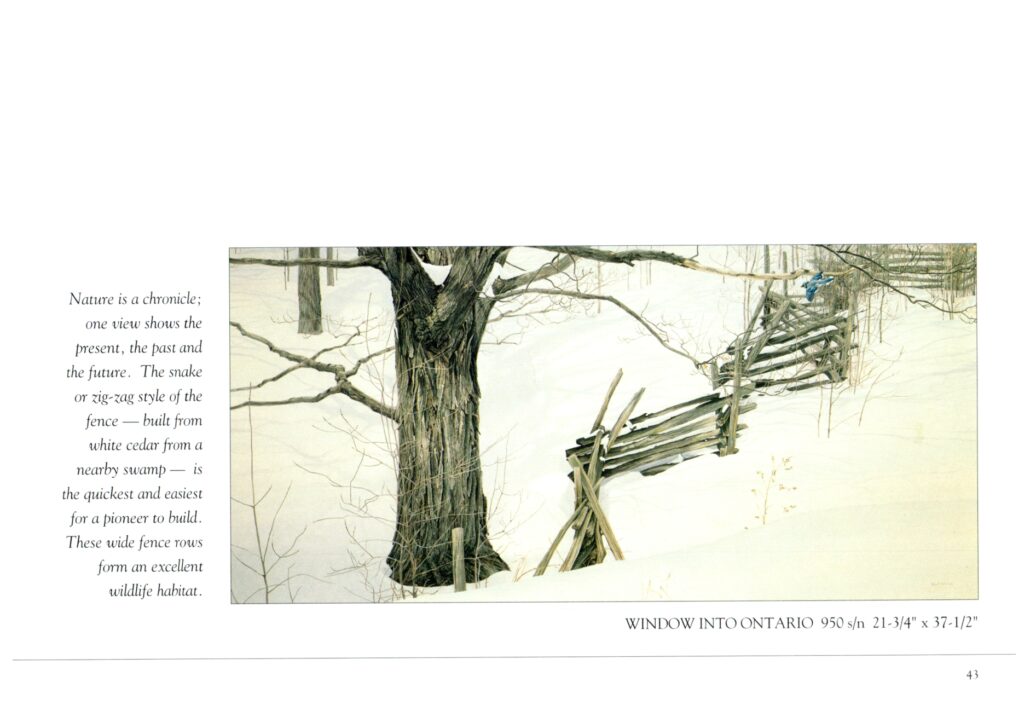
20″ x 40″
“Although this is a picture of my part of the world, it could be many different areas in the northeast.
This is typical of the kind of land that our forefathers first settled when they came to North America.
It was similar to northern Europe in soils and climate. It is the habitat of the pioneer. The gentle
land was cleared first, and the vast tracts of virgin white pine were cut not only to create the fields
for agriculture, but to use in building barns, farmhouses and furniture.
In the rougher land, the forest was allowed to come back. More often than not, the trees which
came back were predominantly hardwoods. Of these, the sugar maple was usually the predominant species. Unlike the birch or aspen, the maple can grow in its own shade and thus perpetuate itself as a climax community.
In this picture you can see the huge old maple which was probably a young tree shortly after the
first clearing. It has now given rise to a variety of ages of younger maples. The mass of saplings
along the fence are all about the same age.
I enjoy looking at nature as a chronicle. You can see in one view not only the present, but the past
and the future. White cedar from a nearby swamp splits very readily in a gentle spiral. The ‘snake’
or zig-zag style of the fence is the quickest and easiest for a pioneer to build, but it does take up
more space. These wide fence rows form an excellent wildlife habitat.
The blue jay’s wings are a variety of blues with white patches. They are like an intense jewel. I
have echoed the blue and white patches of the bird’s wings in an expanded, diffuse way in the
tree shadows on the snow.”
N24-BACK HALL